Choose the power routine you will actually use
A tire inflator is easier to choose when you picture your next pressure check instead of comparing the biggest numbers on the boxes. Ask where you will park, how you will power the tool, and whether you are willing to keep a separate battery charged.
The VIAIR 85P/00085 and DEWALT DCC020IB illustrate two different approaches. This is a comparison of manufacturer documentation and identified product listings, not a hands-on speed, noise, accuracy, or durability test.
You might prefer a simple vehicle-powered setup for occasional top-offs, or you might already have a compatible DEWALT battery and charger for other tools. Neither preference establishes which inflator is faster, and the right decision still depends on your vehicle and the tool’s operating limits.
Think about a normal Saturday morning rather than an imagined emergency. If you cannot conveniently connect, position, and store the equipment during a routine check, you are unlikely to enjoy discovering that inconvenience beside an unfamiliar road.
What the two models document
VIAIR identifies the analog 85P/00085 as an accessory-outlet inflator with a twist-on tire chuck. Its model-specific manual gives a 60 psi maximum working pressure, a 15-amp power requirement, and a manual on/off workflow.
DEWALT identifies DCC020IB as a tool-only corded/cordless inflator with a digital pressure setting and automatic shutoff. Its manufacturer page lists compatible 20V MAX battery operation, a supplied 12V DC cord, and optional 110V AC operation through a separately sold adapter.
Battery, charger, and AC adapter are sold separately for the DEWALT package described here. If you are starting without compatible equipment, compare the complete setup you need rather than treating the bare tool as a ready-to-use cordless kit.
The VIAIR page also groups the press-on 00084 and battery-clamp 00087 beside the 00085. Make sure you are reading the 00085 instructions and selecting its analog twist-on version, rather than assuming every item on that page uses the same connection.
The dial’s scale and the compressor’s working limit are different specifications. A gauge with a higher printed number does not raise the permitted operating pressure, so keep the model-specific manual beside your package comparison.
| Documented feature | VIAIR 85P / 00085 | DEWALT DCC020IB |
|---|---|---|
| Package in this guide | Analog, twist-on chuck | Tool only; 12V DC cord included |
| Power approach | 12V vehicle outlet rated for 15A | Compatible battery, 12V DC, optional AC adapter |
| Stopping workflow | Manual; check actual pressure with motor off | Preset automatic shutoff; stay present |
| Separate preparation | Outlet compatibility and cable route | Battery and charger for cordless operation; optional AC adapter separate |
| Measured comparative speed | Not tested | Not tested |
Picture the cable route before you choose
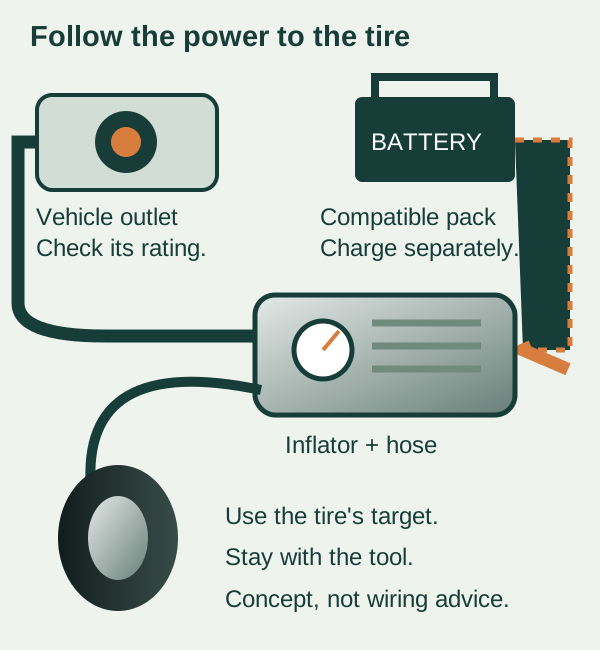
With an accessory-powered inflator, your vehicle’s outlet becomes part of the setup. Check the car’s outlet rating and instructions, the inflator’s requirements, and the conditions under which the outlet can supply power.
You also need a practical route from that outlet to each valve. A cord that reaches one front wheel comfortably may need a different route for the opposite rear wheel, particularly if cargo blocks access inside the car.
Do not route a cable where a door will pinch it or where you must stand in moving traffic to hold the tool. If a safe setup is not possible at your stopping place, getting assistance matters more than demonstrating that the hose can just barely reach.
VIAIR’s 00085 manual requires the engine to run during use and a properly rated outlet. Follow that instruction only in an appropriate open, ventilated setting, and never increase the vehicle circuit’s fuse rating to make an incompatible outlet work.
A cordless setup changes that positioning problem, but it gives you another preparation task. You need the correct charged battery available when you need it, and you need to follow the battery’s storage and charging instructions.
This makes a useful household question: who is responsible for returning the battery to the kit after a woodworking or yard project? If the answer is nobody, a compatible battery you own in theory may not be one you can find on a rainy morning.
A preset changes the workflow, not your responsibility
DEWALT’s documented automatic shutoff lets you select a pressure target rather than relying solely on stopping the motor yourself. You still have to choose the correct unit and pressure, connect the hose properly, and stay with the equipment.
Your target comes from your vehicle’s instructions for its installed tire setup, not the maximum number printed on an inflator. An automatic feature cannot correct a number you entered from the wrong row of a label.
VIAIR’s documented on/off arrangement is a more manual workflow. You need to monitor inflation and stop as instructed, then confirm the result with a suitable gauge instead of treating a moving dial as a reason to look away.
For either approach, make your final check with a method you can repeat. If two gauges disagree, investigate that disagreement rather than using whichever reading makes the task feel finished.
You should also distinguish a routine top-off from an unexplained low tire. Neither tool diagnoses a leak, repairs structural damage, or makes a visibly compromised tire suitable for another journey.
Keep the tire’s job in view
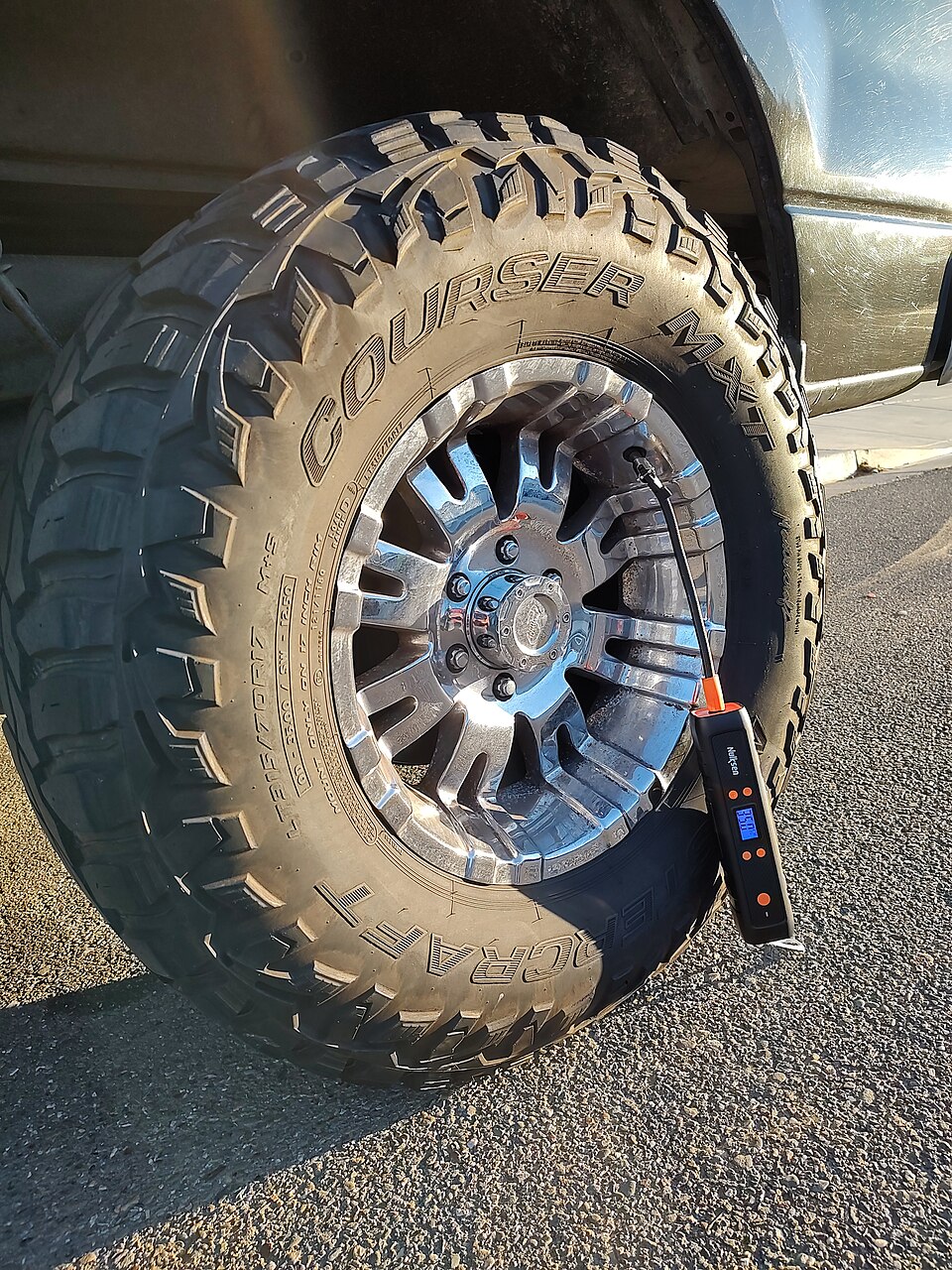
The real inflation scene below shows how a compact tool can be positioned beside an installed tire. It is context for hose routing, not a product test, a recommendation of the pictured inflator, or evidence that either compared model suits that tire.
A large tire can ask more of an inflator than a small pressure correction on an ordinary passenger-car tire. Before you buy, compare your actual tire application with the manufacturer’s instructions rather than assuming that a high pressure rating guarantees an appropriate workload.

Pay attention to rest periods, temperature limits, and restrictions in the current manual supplied with your unit. If those requirements are unclear for your intended job, get clarification before using a tool outside a documented routine.
Do not substitute a review’s headline inflation time for a workload assessment. Different tire volumes, starting pressures, targets, and power conditions can make two impressive numbers poor comparisons even when both manufacturers report them accurately.
Where each approach could fit
The VIAIR approach is worth considering when you want a vehicle-powered tool and are comfortable monitoring a manual inflation process. You first need to confirm that your outlet meets its stated power requirements and that you can safely route the cable to each wheel.
The DEWALT approach is worth considering when you value a preset workflow or can use an existing compatible battery system. If you do not already own that system, include the additional charging equipment and storage responsibility in your decision.
There is no documented result here that justifies calling either tool the fastest, quietest, or most accurate. You can still make a useful choice from supported features without turning a specification comparison into an invented laboratory verdict.
If you need prolonged repeated inflation, unusually high pressure, or service for a tire whose condition is uncertain, neither shortlist entry should be an automatic answer. Identify the required application and choose appropriate equipment or professional help for that job.
Compare the actual package before paying
Read the model number and included items on the selected listing, then compare them with the manufacturer’s page. A case, battery, charger, hose accessory, or adapter pictured nearby may be part of another bundle rather than the item in your cart.
For DCC020IB, the identified US Amazon listing is the tool-only model. For VIAIR, the identified listing specifies 85P/00085 with the analog twist-on setup, matching the model-specific manufacturer instructions used here.
Do not treat a linked price page as a fixed-price promise. Your checkout package, seller, availability, tax, and shipping can change, and this comparison deliberately avoids freezing a price that could mislead you later.
VIAIR 85P / 00085 analog twist-on
 Check Price on AmazonAffiliate link · Amazon listing photo; verify the current selected package at checkout.
DEWALT DCC020IB tool only
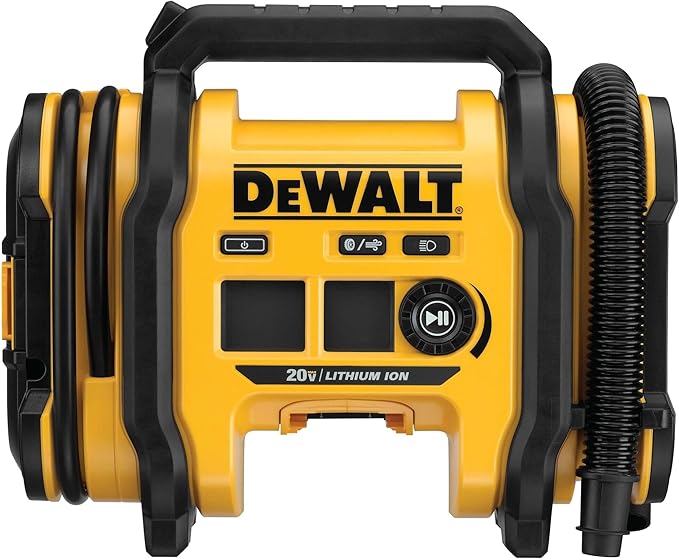 Check Price on AmazonAffiliate link · Amazon listing photo; verify the current selected package at checkout.
Give the tool a place in your maintenance routine
Before the first use, read the supplied manual and make a safe practice setup while the car is parked. Confirm that you can reach all the valves, identify the power connection, and pack the equipment without straining the hose.
Keep your vehicle’s tire-label photo and a dependable gauge with the kit. Those small items make the tool useful by connecting a pressure target to an actual measurement, rather than leaving you with a compressor and a number you remember vaguely.
Choose the setup you can prepare, operate, and maintain consistently. A useful inflator is one that fits your routine and documented application, with no need to invent performance claims to make the decision feel more certain.
Sources & scope
Checked October 15, 2026. Facts are tied to the named source and model; examples and organization are original editorial explanations.
- NHTSA TireWise — Cold pressure, vehicle placard rather than sidewall maximum, monthly checks, warning-system limits.
- VIAIR 85P product family — 00085 twist-on variant distinguished from 00084/00087; no conflicting airflow number used.
- VIAIR 00085 manual, revision R4-080625 — 15A outlet, 60 psi working limit, engine-running requirement, monitor while on and verify pressure while off, dry/ventilated operation.
- DEWALT DCC020IB manufacturer page — Three power options, preset shutoff and tool-only contents; battery/charger/AC adapter separate.
- Amazon listing: VIAIR 85P/00085 — Product title and model/package cross-match only; no review ratings or current price reused.
- Amazon listing: DEWALT DCC020IB — Tool-only title/model cross-match only; no current price or customer rating reused.