A puddle is an observation, not a diagnosis
You walk back to your parked car and notice liquid underneath it. Before deciding which part is leaking, look at the situation from a safe place and consider whether there are warnings, unusual operation, or an immediate hazard that needs professional help.
A wet patch can tell you that something deserves attention without telling you what the liquid is. The pavement, weather, parking history, and vehicle layout all affect what you can reasonably infer from its appearance.
You do not need to touch or taste an unknown liquid to be useful to a repair shop. Keep people and pets away, avoid contact, and call the appropriate assistance if you suspect a dangerous condition or cannot assess the situation safely.
This guide is about documenting what you can observe while the car is safely parked. It is not an instruction to crawl underneath, lift the vehicle, run the engine to recreate a leak, or open hot components.
If the car has a warning or a change in braking, steering, temperature, or another important function, treat that information seriously. A small-looking patch does not give you permission to drive a vehicle with an unresolved safety concern.
Note the location in plain language
Describe where the liquid sits relative to the parked car: near the front, farther back, beside a wheel, or somewhere you cannot see clearly. Use those words as a location record rather than assign a particular component to that spot.
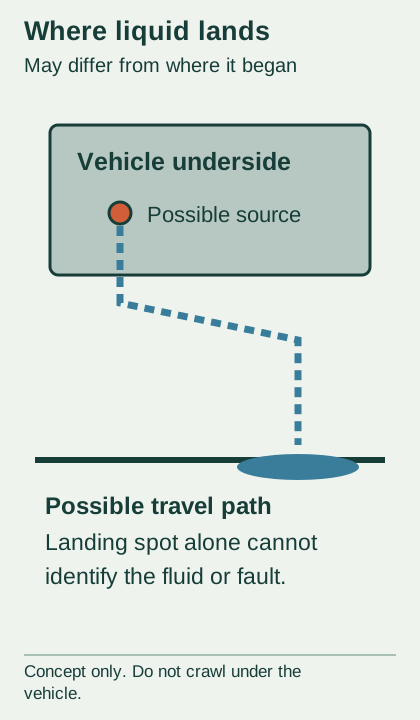
Liquid can move before it reaches the ground, and the place where it lands may not be the original source. A driveway slope or a surface already wet from rain makes that inference even less certain.
Take a photo from a safe standing position if it helps show the relationship to the car. Include enough context that somebody can understand which end of the vehicle is in view, and avoid placing yourself in traffic for a better angle.
Write down whether you know the area was dry before you parked. If you do not know, say so; a mark left by another vehicle should not become part of your car’s repair history by assumption.
The diagram below separates the original source, a possible travel path, and the landing point. It is a simplified explanation of why the puddle’s position alone cannot identify a failed part.

Put timing and conditions beside the photo
Record when you first noticed the patch and roughly how long the vehicle had been parked. Keep the timing approximate if you did not observe the actual start of the drip, instead of creating a precise leak rate from a single look.
Mention whether the air conditioning had been operating, whether it had rained, and whether the car was recently washed or serviced. Those details give a technician useful context without proving an explanation by themselves.
For a documented example, Ford’s 1997 Probe manual explains that air-conditioning operation can produce water dripping from its drain after parking. That is an example of a normal source of water, not a test that identifies every clear puddle beneath any car.
Do not let that familiar explanation cancel other evidence. A warning message, recurring unexplained loss, or a change in how the vehicle operates deserves its own assessment even if the air conditioning was also running.
If you can safely note whether the patch is new or recurring on different parking occasions, save those observations separately. Repetition can help define the complaint, but it still does not establish the fluid type or failed component.
Color helps describe, not identify
You can describe a patch as clear, dark, or colored without turning that description into a confident fluid identification. Lighting, dirty pavement, mixed water, and the fluid’s condition can make a simple color chart misleading.
Avoid matching an online photograph and then buying the product named beneath it. Even if you guessed the fluid family correctly, you would still need the vehicle’s actual specification, the reason for the loss, and the correct service procedure.
Do not use a finger, a close sniff, or a taste as a diagnostic tool. You can communicate the appearance from a normal safe distance and leave identification to someone equipped to inspect the vehicle appropriately.
Keep the photo unfiltered if you plan to show it to a shop. A dramatic contrast adjustment can make a faint mark easier to see while making its color less representative, so explain any edits if you have made them.
If the liquid creates an immediate environmental or other hazard, contact the appropriate local service for advice. Do not wash an unknown automotive fluid into a drain simply to make the parking area look clean.
Check information before checking reservoirs
If you are considering any basic level observation, first read your exact owner’s manual and confirm the vehicle is in the required condition. Do not open a cap or reach into the engine bay just because a general guide says a reservoir is easy to find.
The 2024 Ford Explorer brake-fluid section, for example, describes reading its reservoir level and says an out-of-range level needs inspection. It also warns about contamination and incorrect fluid, which is why a low reading is not an invitation to add whatever bottle you have.
Cooling systems carry their own hot-system precautions. Leave hot cooling caps alone, and follow the exact vehicle instructions rather than treat the absence of visible steam as proof that everything is safe to touch.
If you cannot confidently identify the reservoir or required conditions, stop at the observation stage. A clear report that you did not perform a check is more useful than a measurement from the wrong container.
Write down the manual section you consulted and any reading you safely obtained. Keep that separate from the puddle description so you do not accidentally present two uncertain observations as a confirmed diagnosis.
Make the drive-or-help decision with the right person
If you suspect a safety-related fluid loss or the vehicle has a warning or abnormal operation, get qualified advice before driving. Tell the assistance provider what you observed and let it help determine the appropriate next step for the actual situation.
Describe the location and surroundings first if the vehicle is in an exposed or inconvenient place. You may need recovery or another practical arrangement before the shop can investigate the source.
Avoid asking a general internet comment section for a guaranteed distance you can drive. The size of a patch in a photograph cannot establish the vehicle’s condition, remaining fluid, or the consequences of continued operation.
You can say that the liquid is unidentified and still make a useful call. Provide the car’s details, your observations, relevant warnings, and whether you have moved it since noticing the problem.
If the advice is to leave the car parked, solve the transportation issue separately. That removes some of the pressure to turn a hopeful explanation into permission to keep using it.
Give the shop a clean record
Bring the photos and a short timeline to the inspection. Ask the shop to identify the source and explain how its findings relate to the patch and any other symptoms you reported.
Mention recent work without automatically blaming it. An invoice gives the technician something concrete to review, while a neutral sequence helps everyone distinguish a possible connection from a proven one.
After the repair or assessment, save the explanation and any follow-up instructions with your service records. If the patch returns, your next conversation can start with what was actually found rather than repeat the same color-based guess.
The useful result is an honest account of where, when, and under what conditions you noticed liquid. You can collect that information without touching unknown fluids or pretending that a puddle photograph is a complete inspection.
Sources & scope
Checked October 15, 2026. Manufacturer examples apply to the named model and document. Reader scenarios and organization are original editorial explanations.
- 2024 Ford Explorer: brake fluid check — Reservoir level, correct fluid and contamination cautions, model-specific example.
- 1997 Ford Probe manual, printed p.53 — Air-conditioning drain water after parking is a documented normal example, not a universal puddle diagnosis.
- 2024 Ford Explorer: coolant check — Hot-system precautions.