Describe what happens when you ask the engine to start
When your car will not start, the first helpful distinction is whether the engine turns over. A no-crank problem means it does not crank; a crank-no-start means you hear the engine turning but it never settles into running.
Those labels describe behavior rather than identify a failed part. You can use them to give roadside assistance a clearer report without diagnosing a battery, starter, fuel system, or control module beside the road.
Begin with your location and safety, not a series of experiments. If you are exposed to traffic, smell fuel, see smoke, or suspect another immediate hazard, move to a safe position as circumstances permit and request appropriate help.
This guide concerns describing conventional engine starting behavior. Hybrids and electric vehicles may indicate readiness differently, so silence after pressing a button is not enough to decide that one of those vehicles has failed to start.
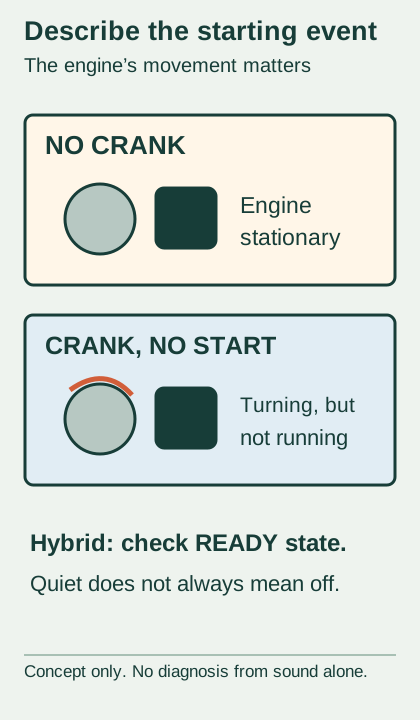
Listen for engine movement, not just any sound
An ordinary combustion engine makes a recognizable repeating cranking sound before it runs. If you heard that sound during the unsuccessful attempt, report that the engine cranked rather than merely saying that the car made noise.
A single click or rapid clicking is a different observation from the sound of the engine turning. Describe the sound itself and let the technician determine what it means instead of using a click as proof of a particular failed component.
A whirring noise can also be difficult to interpret from the driver's seat. If you cannot tell whether the engine moved, say that you are unsure and describe what you heard rather than forcing the event into one branch.
Do not keep repeating attempts just to make your description more certain. If you already have a safe audio recording or a passenger's observation, keep it, but another starting attempt is not automatically worth the additional uncertainty or risk.
Never reach into the engine compartment to watch belts or other parts during an attempted start. Your listening observation belongs at the controls, with people and loose objects kept clear of the machinery.
If nothing cranks, check the normal starting conditions
Read your vehicle's starting instructions and look for an obvious unmet condition that you can correct normally. That may involve the specified gear position, brake or clutch input, or the vehicle recognizing the correct key.
For a concrete example, the 2024 Ford E-Series gasoline starting instructions specify a parking brake, the permitted transmission position, and brake-pedal input. Those details illustrate why you should use the instructions for your own vehicle rather than adopt another model's sequence.
Record any message such as a key-detection warning or a request to press a pedal. The exact displayed wording gives the person helping you a better starting point than your interpretation that the computer is broken.
If your manual provides a procedure for a weak key-fob battery, follow that exact procedure. Do not assume that changing the vehicle's main battery is the appropriate response to a message about the key.
Keep any permitted retry within the manual's directions. Bypassing a starter, bridging terminals, defeating an interlock, or trying random gear-selector tricks moves well beyond a normal owner check and does not belong in this process.
If the engine cranks, record whether it ever catches
A crank-no-start report becomes more useful when you describe whether the engine never fires, briefly catches and dies, or turns more slowly than usual. These remain observations, so you do not need to decide which internal system produced them.
Note whether the car had just been driven, had sat overnight, or had been parked for a longer period. Add any recent refueling, service, warning message, or unusual event without assuming that timing alone proves the cause.
Check the fuel indication as an observation, but do not treat an indicated amount as a complete fuel-system diagnosis. Likewise, a dashboard that lights up does not establish that every electrical part of the starting system is operating correctly.
Avoid spraying starting fluid, removing fuel lines, or testing for sparks. The value of identifying crank-no-start is that you can request appropriate diagnosis without performing hazardous tests you are not equipped to interpret.
If the vehicle starts briefly and then stalls, report that exact sequence. Saying that it never started would hide a useful detail and might send the next conversation down the wrong path.
Know when a silent start can be normal
Some hybrids can enter a ready-to-drive state without immediately running the gasoline engine. The 2017 Ford C-MAX Hybrid manual describes this behavior and tells the driver to look for its readiness indicator.
If you drive a hybrid, check the manual's readiness display and starting instructions before using engine noise as your test. An engine that is quiet while the vehicle indicates ready is a different situation from a vehicle that never reaches ready.
For a battery-electric vehicle, an engine-cranking checklist does not apply at all. Record the readiness messages and follow the manufacturer's troubleshooting and assistance guidance for that vehicle.
Keep low-voltage and high-voltage systems distinct in your conversation with roadside assistance. Do not touch high-voltage cables or assume that a portable jump starter can be connected wherever an ordinary under-hood battery might be found.
You can provide the exact model and powertrain when you call for help. That information helps the provider plan an appropriate response without requiring you to inspect unfamiliar electrical equipment.
Stop before repeated attempts become the whole plan
Your manual may limit how long and how often you can operate the starter. Respect those limits and waiting periods instead of adopting a universal number of seconds from a different vehicle's troubleshooting page.
Repeated attempts can also make your account less clear if the behavior changes as the situation develops. Write down the first attempt and any later difference so the technician can distinguish the original concern from what happened afterward.
If you suspect a weak battery, use your manual and any equipment instructions before deciding whether a jump is appropriate. Do not connect a pack to a damaged, leaking, frozen, or otherwise suspect battery, and request professional help when compatibility or condition is uncertain.
A successful jump would not by itself explain why the vehicle needed assistance. Ask what battery and charging-system follow-up is recommended rather than treating a running engine as proof that the original cause has vanished.
If you are in a garage, do not leave a running vehicle there as part of your investigation. Exhaust presents a separate hazard, and starting successfully should not turn into an extended indoor test.
Give the assistance provider a short usable handover
Start the call with where the vehicle is, whether it is safely accessible, and its exact year, model, and powertrain. Then describe no crank, cranks without starting, starts then stalls, or uncertainty about what you heard.
Add the warning messages, number of attempts, recent history, and anything already connected or changed. If another person tried a jump or cleared codes, include that fact instead of leaving the next technician to discover it.
Ask whether the provider wants you to leave the vehicle as it is and what access will be needed. If towing is required, follow the vehicle's towing guidance and let the provider know about drivetrain or readiness issues.
Your most useful contribution is an accurate account that preserves the starting point. You do not need to select a replacement part before help arrives; you need a safe location, the correct instructions, and a clear description of the engine's behavior.
Save the assistance report and the eventual diagnosis together, including whether the engine behaved differently when help arrived. That short record can be particularly useful if the same intermittent starting problem returns weeks later.

Sources & scope
Checked October 15, 2026. Manufacturer examples apply to the named model and document. Reader scenarios and organization are original editorial explanations.
- 2024 Ford E-Series Owner Manual: Starting Gasoline Engine — Model-specific parking brake/transmission/brake input and exhaust caution; no transfer of exact sequence to other cars.
- 2017 Ford C-MAX Hybrid Owner Manual: Hybrid Operation — Hybrid readiness may precede gasoline engine running; exact readiness display is model-specific.
- Bosch Auto Service: Car Will Not Start — Accessory lights alone do not prove starting-system condition; clicking has several possible causes; no voltage or diagnosis shortcut reproduced.