Find out which side of the glass is dirty
Your wipers sweep, but the view still looks smeared. Before ordering blades, park safely and work out whether you are looking at dirt on the outside, haze on the inside, or an actual wiping problem.
An interior film stays in place while the blades move outside it. You can waste a new set of wipers trying to clear that film, so begin with both surfaces instead of assuming every visibility problem belongs to the rubber.
If your view is too poor for safe driving, stop somewhere safe and deal with it before continuing. A quick wash-cycle experiment in moving traffic is a poor substitute for a deliberate check while parked.
Ford's 2018 Fiesta manual explains that environmental deposits and car-wash chemicals can contaminate both the windshield and blades. That gives you a sensible first hypothesis to check, without proving that cleaning will fix a torn blade or a damaged arm.
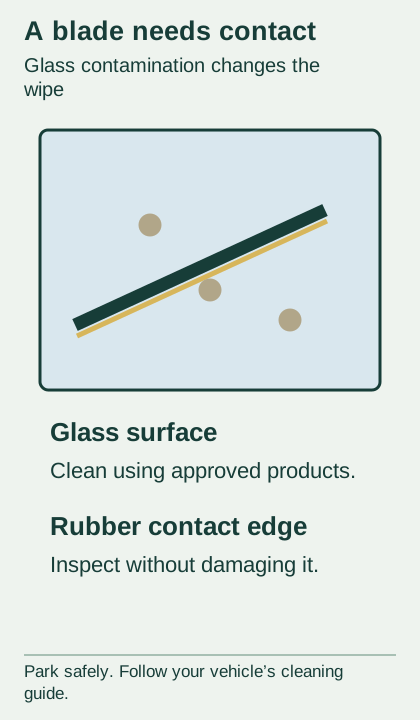
Describe the pattern before you change it
Look at the wipe pattern with the vehicle safely stationary and the glass wet according to your car's instructions. Do not run the blades repeatedly across dry dirt to create a more obvious demonstration.
A broad haze, a narrow persistent line, and a section that does not clear are useful descriptions for your notes. None identifies a failed part on its own, but each helps you compare the result after cleaning.
Notice whether the issue affects one side, both sides, or the rear window too. Treat each location separately because its blade, glass surface, and access arrangement may differ.
If the smearing started after a car wash or a windshield treatment, write down what was applied. You can then ask the product maker or vehicle manufacturer about removal rather than layering another unknown chemical over the first.
You do not need to photograph the problem while driving. A parked photograph of the wet glass and a short written description are enough to preserve what you observed without turning the check into another distraction.

Clean ordinary contamination with compatible products
Find the cleaning instructions for your vehicle and any special glass or blade coating before selecting products. The 2018 Fiesta manual specifies non-abrasive glass cleaner for ordinary windshield cleaning, but your own manual controls the exact products and methods for your car.
Use a clean cloth and work across the whole outside windshield rather than polishing only the stripe directly in front of your face. Otherwise, you can leave contamination in the next part of the blade's sweep and immediately carry it back.
Keep the cleaning materials for glass separate from cloths used on tires, oily engine parts, or waxed bodywork. Starting with a dirty cloth makes it difficult to tell whether the glass is actually improving.
Wipe the interior glass with an approved cleaner applied as its instructions direct, protecting surrounding trim and screens. Ford cautions against leaving glass cleaner on the instrument panel and door panels, so clean any accidental contact promptly.
Do not treat a strong solvent, abrasive pad, or internet polishing trick as a universal next step. If ordinary cleaning fails, check the vehicle and coating guidance for the specific contamination instead of escalating at random.
Handle the blades without risking the windshield
Check how your vehicle permits access to the wipers before lifting an arm. Some designs need a service position, and lifting a blade from its normal parked position may cause interference with the hood or other parts.
Once access is permitted, support the arm carefully and avoid letting it snap back onto the windshield. Keep the blade attached unless you are following the correct replacement procedure and have the right part ready.
Use the cleaning method approved for your particular blades. Ford's Fiesta guidance names rubbing alcohol or washer concentrate, but that example is not permission to apply alcohol to every coated aftermarket blade without checking its instructions.
Clean the rubber gently, then look for a split edge, missing section, obvious deformation, or loose attachment. If you find damage, record it rather than assuming another aggressive cleaning session will restore the material.
Do not bend the arm to improve contact or force the blade through an unfamiliar hinge. That moves you from cleaning into changing the mechanism, where the correct service information and professional assessment may be needed.
Check the washer system as a separate job
A blade needs an appropriate wet surface, so notice whether the washer actually reaches the intended windshield area. An empty reservoir, weak delivery, or a blocked pattern can make the wiping result look poor even when your shopping list contains only blades.
Use the washer fluid specified for your vehicle and suitable for the conditions where you drive. Do not improvise a mixture from household detergents or assume that a summer product suits freezing weather.
If nothing sprays, check the manual's permitted owner checks and record what you hear or see. Avoid inserting sharp objects into unfamiliar nozzles or repeatedly running a system that may be empty or frozen.
Keep the washer issue separate in your note: the glass may be clean, the blade may look intact, and fluid delivery may still need attention. A shop can investigate more efficiently when you describe each result rather than calling the entire system bad.
After correcting an obvious fluid issue, evaluate the wipe again while parked. You are testing whether the view improves under normal wet operation, not trying to wear a dry smear away through repeated cycling.
Compare the result and choose the next step
Once the glass and blades are clean, repeat the same parked wet-glass observation. Use your original description so you can tell whether a broad film improved even if one narrow line remains.
If cleaning restores a clear sweep, keep the products and method in your maintenance notes. You now have a repeatable first step when the same kind of contamination returns, without assuming the blades will last indefinitely.
If the edge is torn or the same clearing problem persists, verify the correct replacement blade for each position. The driver, passenger, and rear blades may differ, so check lengths, attachment types, and the vehicle application rather than ordering a visually similar pair.
If a replacement still does not clear properly, or the arm appears damaged or loose, arrange inspection. Buying a third blade design is unlikely to be an efficient way to understand a problem that may involve the mechanism or glass.
Ask the installer to show that the attachment is secure and that the blades park and sweep correctly. Keep hands, cloths, and tools clear whenever the wiper system is operating.
Keep the next rainy drive uneventful
Do the check before rain is forecast when possible. A driveway appointment with your own glass gives you time to find the service-position instructions and replace an unsuitable cleaning cloth without pressure from traffic behind you.
In freezing conditions, follow the manual's instructions for clearing ice and freeing the blades before operation. Do not ask the motor and rubber edge to remove a frozen obstruction that you have not dealt with properly.
Include the rear window in your regular inspection if the vehicle has a rear wiper. It is easy to notice only the windshield until a wet parking maneuver reveals that the rear view is also smeared.
The useful outcome is a clear view under normal operation and a defined next step for anything that remains. Cleaning, blade replacement, and mechanical inspection are different decisions, and your observations help you choose the one that fits.
Keep the replacement package until you have confirmed the result, especially when adapters were supplied with the blade. Its application information can help the installer check the part without another uncertain search through similar-looking products.
Sources & scope
Checked October 15, 2026. Manufacturer examples apply to the named model and document. Reader scenarios and organization are original editorial explanations.
- 2018 Ford Fiesta Owner Manual: Cleaning Windows and Wiper Blades — Contamination; non-abrasive glass cleaner, trim protection, blade cleaner example; stronger abrasives not generalized.
- Bosch: Tips and Tricks for Replacing Wiper Blades — Service-position manual, raised-arm glass damage risk, exact installation instructions.