Identify the installed system before buying a bulb
Two cars with the same model badge can use different headlights. If you shop by model name alone, you can end up comparing a simple replacement bulb with a part intended for an entirely different lighting system.
Start with the exact year, trim, and lighting option, then consult the owner's manual and a manufacturer parts lookup. If the car is used or modified, ask a qualified shop to confirm what is actually installed before you rely on the original equipment list.
Halogen, HID, and LED describe ways of producing light, but your headlight is a complete assembly that also controls where that light goes. A part that fits through an opening is not automatically a suitable substitute for the light source the assembly was designed around.
Your goal is a documented match between the vehicle, the lamp assembly, and its service parts. You can make that match without opening unfamiliar high-voltage components or guessing from the color of light reflected on a garage door.
Understand the three light sources in ordinary terms
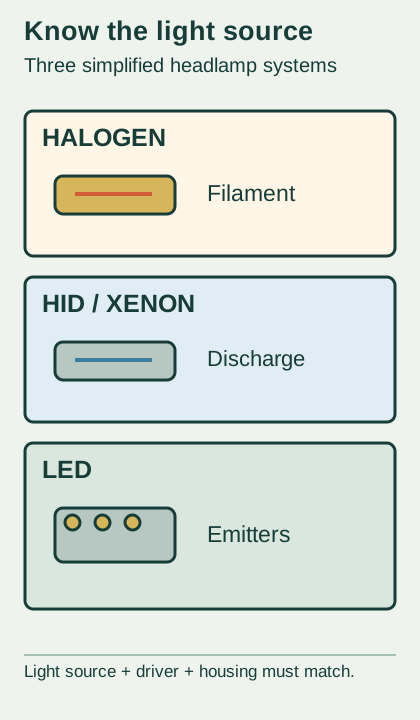
A halogen lamp produces light with a heated filament inside a capsule. If your manual lists a replaceable halogen bulb, its exact designation and rating matter more to your order than the general word halogen.
HID stands for high-intensity discharge, and these automotive lamps are often called xenon headlights. HELLA describes a system that includes the discharge lamp, a ballast, and the optical components that shape the beam.
LED means light-emitting diode. An LED headlamp uses semiconductor light sources with supporting electronics and thermal management, and its service arrangement depends on the exact vehicle rather than a universal screw-in replacement rule.
HELLA's technical material illustrates these as different technologies with different supporting parts. Use that distinction to understand a repair proposal, not as a ranking that promises every LED assembly will outperform every halogen assembly in your driving conditions.
The labels answer how the system makes light. They do not by themselves answer how well a particular car illuminates the road, what its repair costs will be, or whether an advertised replacement suits it.
Do not identify the low beam by its neighbors
A modern lamp cluster can contain several lighting functions, so an LED strip around the edge does not establish that the low beam also uses LEDs. Identify the specific function that has failed before researching parts.
Write down whether the concern affects low beam, high beam, a daytime running lamp, a turn signal, or another function. A clear description prevents a parts search from silently switching to whichever bulb is easiest to find.
Light color is also a weak shortcut. Product descriptions and photographs can make different systems look similar, and the image on a screen does not reliably identify the equipment installed behind your own lens.
If the manual lists multiple equipment options, do not choose whichever looks closest in an illustration. Use the vehicle's build information and the actual assembly identification, with dealer or repair-shop help when needed.
A useful record contains one wider photograph of the front corner and a readable photograph of any safely accessible identification label. You can gather that information with the lights switched off and the vehicle secured.
Read the service instructions before opening anything
Your manual may describe replacing a bulb, replacing an assembly, or having a dealer handle a particular light source. Find that instruction before removing covers, because the procedure determines whether this is an ordinary owner task for your car.
If the system uses HID equipment, leave unfamiliar electrical diagnosis to a qualified professional. HELLA's xenon material identifies the ballast and ignition system as part of the setup, so this is not a place to improvise a live test by disconnecting components.
For a permitted halogen replacement, follow the exact handling and installation instructions that accompany the vehicle and bulb. Do not assume a generic video shows the correct access route, orientation, or handling precautions for your assembly.
For an LED system, ask which component is actually serviceable. A quote for a module, driver, or complete assembly should identify the diagnosed part rather than implying that every dark LED headlight needs the same replacement.
If access requires removing unfamiliar body parts or placing the vehicle on a lift, consider professional service. The simplicity of a bulb's packaging does not tell you how involved its installation is on your car.
Treat a conversion as a different decision
Replacing the specified failed part and converting the lighting technology are different projects. Keep them separate when evaluating prices, so a low-cost retrofit kit does not distract you from the documented repair your vehicle needs.
NHTSA's published LED headlamp interpretation distinguishes compliant complete headlamp designs from LED sources offered for replaceable-bulb headlamps. Availability on an online marketplace is therefore not sufficient evidence that a proposed substitution meets the relevant requirements.
Before considering a conversion, ask for documentation of the exact assembly, light source, vehicle application, and applicable federal and state requirements. Do not accept a generic street-legal label as the whole explanation.
This article does not establish that a particular conversion is lawful in your state or suitable for your vehicle. If the supplier cannot substantiate the exact combination, keep the original specified system and seek qualified guidance on the repair.
Avoid judging a conversion only by how bright it looks when you stand in front of the car. You also need the intended beam distribution and control of glare for other road users, which a casual driveway impression cannot certify.


Make the repair quote specific enough to compare
Ask the shop to name the failed function, identify the existing lighting type, and list the exact replacement part. You can compare two quotes much more fairly when both address the same equipment and scope.
If a quote includes the complete assembly, ask why a smaller service part is unsuitable or unavailable for the diagnosed problem. The answer may be straightforward, but it should refer to your actual lamp and diagnosis rather than a blanket statement about modern cars.
If a quote includes additional setup or adjustment, ask what the manufacturer procedure requires. Do not delete that line from the estimate merely because a replacement lamp appears to illuminate when plugged in.
If the car has aftermarket lamps, tell the shop before ordering. The repair may need to account for altered wiring or non-original assemblies, and the factory parts lookup alone may not describe what the technician finds.
Keep the old and proposed part numbers in your record until the work is complete. If a supplier changes a part number, ask for confirmation that the replacement is appropriate instead of treating every number change as either harmless or disqualifying.
Verify the finished job without inventing a beam test
At handover, ask the installer to confirm the lighting functions, secure installation, and any manufacturer-required adjustment or setup. A lamp that turns on is one part of the result, not the entire service check.
Inspect the visible lens and surrounding area while parked and tell the shop about any unresolved warning message. If a function still fails, document which one rather than describing the entire front lighting system as intermittently broken.
On your next ordinary evening drive, note any visibility concern and return to the installer for assessment. Do not repeatedly aim at other drivers, improvise an aiming specification, or assume that a brighter-looking patch of pavement proves a better beam.
Save the exact replacement details with the vehicle's records. The next time a lamp needs service, you will have a starting point grounded in the equipment on your car instead of another round of guesses about halogen, HID, or LED.
When a parts counter asks which lighting package you have, treat that as a useful question rather than an inconvenience. Finding the answer before payment is much easier than discovering the wrong part with the car partly disassembled.
Sources & scope
Checked October 15, 2026. Manufacturer examples apply to the named model and document. Reader scenarios and organization are original editorial explanations.
- HELLA: Bulbs Technical Brochure — Halogen filament, HID discharge, LED light source; technology concepts only, European legal statements not applied to US.
- HELLA: Xenon Headlights — Discharge source, ballast/ignition and optical assembly; no hazardous diagnostic instructions reproduced.
- NHTSA: LED Headlights Interpretation — Distinguishes integral LED systems from replaceable light-source headlamps; marketplace availability not compliance evidence; no individual legal verdict.