Your gentle commute can still deserve a second look
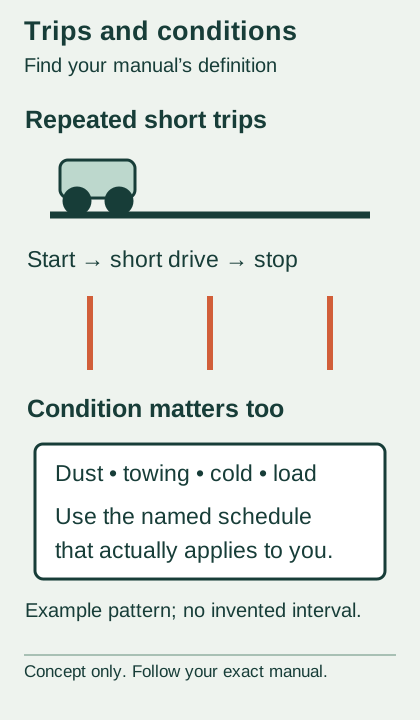
“Severe service” sounds like a label for a work truck climbing a mountain with a trailer. When you read your own maintenance instructions, though, you may find everyday patterns such as repeated short trips or extended idling listed alongside more obvious heavy use.
You aren't trying to award your driving a toughness score. You're trying to match a real pattern to the conditions defined by the manufacturer, then identify the particular maintenance changes that follow from that match.
The useful question is therefore more precise than “Am I a severe driver?” Ask which conditions apply to your vehicle, how often they occur, and which entries in its maintenance schedule specifically address them.
Read the definition for the vehicle you own
Start with the correct model year, engine, and market, then look for headings such as special operating conditions, demanding use, or severe service. Manufacturers don't have to organize their schedules around the same label, and you shouldn't assume that a list from another brand applies unchanged.
As one named example, the online 2024 Ford Edge manual identifies short trips, unusually hot or cold conditions, dust, extended idling, and heavy loads or towing as severe-use situations. It directs you to the relevant severe-service maintenance entries rather than inviting you to invent a shorter interval for every component.
That example is useful for recognizing how ordinary a listed condition can sound. It doesn't establish a universal short-trip distance, temperature cutoff, or service frequency, so use the actual wording for your car when deciding whether your routine qualifies.
Keep exceptions and footnotes next to the main definition. A condition may change the requirement for one fluid or filter without changing everything else, and losing that connection can turn a targeted instruction into an unnecessarily broad service package.

Describe a week instead of guessing a category
Write down a representative week in plain language: where you drive, how long each outing lasts, whether you tow, and how much time you spend stationary with the engine operating. You don't need a complicated logger; a few honest notes will make a conversation with a shop much more useful.
For example, your weekly mileage might look low because every errand starts from home and ends nearby. Recording the separate outings reveals a pattern that a single monthly odometer total doesn't show, without requiring you to guess what temperature the engine reached on each trip.
Include changes across seasons if they matter to your routine. A car that makes long drives during summer travel may spend winter doing quick local errands, so an annual average can conceal the period you actually need to discuss.
Record sustained patterns and occasional events separately. “Tow a camper on three vacation days” gives a technician different information from “tow a loaded trailer most workdays,” even when both activities deserve a check against the manufacturer's towing instructions.
Let the condition point to a specific item
Once you've described your use, make a short list of the matching manual entries. For each one, write the applicable condition, the affected service, and the instruction that changes, leaving unrelated maintenance under its own normal requirements.
This keeps a dusty-road question from turning automatically into a transmission-fluid decision. It also helps you notice when the manual asks for an inspection or an as-needed replacement rather than a fixed new interval that you can simply put on a calendar.
The Edge schedule, for example, connects dusty and dirty exposure with more frequent inspection and replacement of the engine and cabin air filters. That's a specific relationship to check; it isn't a promise that replacing either filter cures any symptom you notice.
If two conditions apply, don't combine their instructions by intuition. Show the exact passages to a qualified shop or the manufacturer and ask which schedule controls the affected item, especially when the wording or equipment applicability is unclear.
Understand what your dashboard can and cannot answer
Your dashboard may provide maintenance information, but you still need its manual explanation to know what is being tracked. Don't assume that a percentage or service message accounts for every special-use requirement, every fluid, or every calendar deadline.
Make a separate line in your plan for “monitor instructions checked.” Under it, note the manual section explaining the display and any related maximum limits, so the next person who uses the car doesn't treat one reassuring number as a complete health report.
Suppose you change from a long commute to delivery work with many stops. The useful response is to review your actual schedule and monitor instructions, not to force the display to agree with an interval you found in a discussion forum.
Likewise, a routine without severe-use conditions doesn't mean you can skip the normal schedule. You're choosing the applicable instructions for your use, while warning lights, new symptoms, or known damage still require their own attention.
Ask the shop for a readable explanation
Bring your driving notes and the relevant pages to the service desk. You can say, “These are my usual trips and these are the conditions I found; which maintenance entries apply, and can you show me where?”
If the recommendation is “our severe-service package,” ask what each included task does and why it belongs on your vehicle now. A clear explanation should connect the service to your schedule or an observed condition, rather than relying entirely on the package name.
Keep the proposed work separate from the description of your driving. That way, you can compare future recommendations without losing the original reason, and a different technician can understand the question without starting the conversation from scratch.
When a shop identifies an inspection finding, ask to have that recorded as a finding. Your driving pattern may explain why an inspection is sensible, but it doesn't itself prove that a component is worn, a fluid is contaminated, or a replacement is due today.
Change the plan when your life changes
Treat the schedule decision as something you can revisit after a meaningful change, such as moving to an unpaved road or starting to tow regularly. Write down when the new use began, because that date helps explain later discussions about service history.
Avoid repeatedly rewriting old entries to make your records look more consistent. Keep what was done and why, then add the new interpretation and its source; your goal is a truthful maintenance history, not a tidy story that hides uncertainty.
If you buy a used vehicle, describe the use you know and label the earlier use unknown. You can request records or an inspection without assuming that an apparently clean car lived an easy life or that missing paperwork proves neglect.
The practical outcome should be a small, specific set of actions: the correct schedule section saved, the relevant tasks identified, and any unclear applicability question sent to someone who can resolve it. Once those pieces are in place, severe service becomes a maintenance decision you can explain instead of an intimidating label.
One useful appointment note contains both the ordinary week and the unusual event: “Local errands most days; one long trip with a trailer last month.” That combination gives the person advising you a starting point, while the manual still determines which instruction applies.
When the answer arrives, save the relevant section and the explanation together. The next time your routine changes, you'll be able to compare the new facts with an identifiable earlier decision instead of starting from an unexplained “severe” checkbox in an app.
You can also share that short note with another driver of the car. It invites them to add information you may not know, such as regular gravel-road travel or long periods of idling, before you finalize the maintenance plan.
Sources & scope
Checked October 15, 2026. Manufacturer examples apply to the named model and document. Reader scenarios and organization are original editorial explanations.
- 2024 Edge special-use definition includes short trips/extreme temperatures/dust/idling/heavy loads; dusty use affects engine and cabin filters. — 2024 Edge special-use definition includes short trips/extreme temperatures/dust/idling/heavy loads; dusty use affects engine and cabin filters..