Treat the color as an observation, not an answer
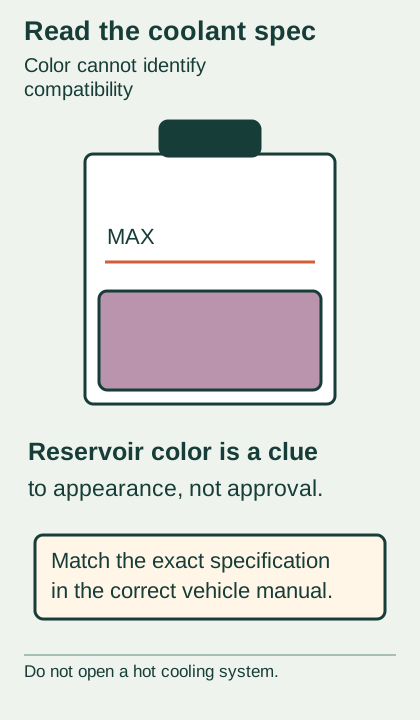
You look through the coolant reservoir and see pink fluid, then find a shelf full of pink, orange, yellow, and green jugs. Matching the shade feels sensible, but it doesn't tell you which exact product meets your vehicle's requirements or what someone previously put in the system.
Start with the vehicle's cooling-system instructions and the required specification instead. You can record the color as part of the history, while keeping product identity, compatibility, and the reason for adding fluid as separate questions to resolve.
This matters even when you only plan a small top-off. Before anything goes into the reservoir, you need to identify the right system, confirm the approved product and preparation, and follow the manufacturer's conditions for checking and adding it.
Let the cold system stay closed while you identify it
If the engine or cooling system is hot, don't remove a pressure cap to get a better look. Ford's 2018 GT coolant-check section warns that hot pressurized liquid and steam can escape forcefully; use your own vehicle's cold-check instructions rather than treating a generic wait as proof that it's safe.
Use the manual's component diagram to identify the coolant reservoir and its markings. If you can't establish which container you're looking at, stop there; a familiar-looking translucent bottle or colored cap isn't enough to choose where a fluid belongs.
You can gather documents, read labels, and plan questions while leaving the system closed. A low reading or an overheating warning needs the vehicle's specified response, and an empty container isn't an invitation to pour in whichever liquid you already have nearby.

Find the specification before shopping by appearance
Write down the exact model year and engine, then locate the coolant specification and any preparation instructions in the owner's manual. Keep that information with the maintenance procedure so you don't separate the product choice from the conditions under which it can be added.
For an original shopping note, leave distinct spaces for the required specification, the chosen product name, and whether the package is ready to use or concentrated. Fill them from the actual documents and label rather than assuming a jug's color tells you how it is prepared.
If the manual's wording and a product claim seem to conflict, ask the vehicle manufacturer or a qualified shop to resolve the question for your vehicle. A conversation is more productive when you can show the exact two statements instead of asking whether “the orange stuff” is okay.
Color can change without identifying a different product
The 2018 GT instructions provide a useful, narrow example: the specified coolant can change from orange toward pink or light red during use, and the manual says that change alone doesn't mean it has degraded if it remains clear and uncontaminated. That is a model-specific explanation, not a way to certify an unknown pink fluid in another car.
The practical lesson is to avoid converting appearance into a product identity. If two samples look alike, you still haven't established their formulation or suitability, and if one sample changes shade, you haven't automatically established the need for a flush.
When you report a concern, describe the color and any visible change without declaring a diagnosis. “It looks different from the last cold check” gives a technician an observation to investigate; “the coolant has failed” claims a conclusion you haven't verified.
Read broad compatibility claims in their actual context
Product manufacturers may publish claims that span several factory colors, which is another reason color matching isn't a complete selection method. For example, Prestone's US MAX American Vehicles Orange page describes its named product as suitable for certain Ford, Lincoln, and Mercury applications using orange, gold, or yellow coolant.
That is Prestone's product claim for the stated application range, not our instruction to combine fluids in your car. Compare the exact product documentation with your manufacturer's requirements, and resolve any uncertainty before using it.
Don't transfer a claim from one product line to another bottle from the same brand. Check the full name, part number where provided, and current label, because a shelf organized by brand or color may group products whose claims aren't identical.
A photo of the back label is useful when you ask for clarification. It lets the person helping you see the actual compatibility statement and preparation instructions, instead of relying on a shortened retailer title or your memory of the packaging.
Unknown service history needs an honest question
If you bought the car used, look for a receipt that identifies the coolant actually installed and the work performed. A general “cooling system service” note may be a useful lead, but it doesn't automatically document the exact product, concentration, or procedure.
If you can't establish the previous fill, tell the shop that directly. Ask how they recommend resolving the uncertainty for your particular vehicle, rather than declaring compatibility from the reservoir color or asking a counter clerk to guess from a phone photograph.
Avoid adding extra treatments to make an unknown mixture seem more reassuring. The cited GT manual specifically warns against unspecified cooling-system additives and sealants; follow your own manufacturer's directions and have a suspected problem assessed instead of experimenting with a stack of products.
Keep the answer and any resulting service record together. A documented product identity gives the next maintenance visit a better starting point than another guess about what the fluid used to look like.
Keep routine level checks separate from a leak investigation
Use the correct cold-level markings and checking procedure for your vehicle when you record a routine observation. Note the date, mileage, and conditions so a later check can be compared fairly, while avoiding a universal fill level or quantity for every reservoir.
If the level repeatedly falls, report the pattern and follow the manufacturer's instructions about operation and service. Adding more fluid records a top-off; it doesn't identify the cause of the loss or establish that the underlying problem has been repaired.
For a useful handover, say what you observed and what you added, including the exact product and amount if known. Keep any overheating message or other symptom in the same note, because a color description by itself leaves out the circumstances that matter to diagnosis.
Leave yourself a record that prevents the next guess
After an authorized coolant service, ask the invoice to identify the product or specification and the work actually completed. Keep the record alongside the manual reference, with any unresolved question clearly marked instead of writing a reassuring answer that nobody confirmed.
Store leftover product in its original labeled container according to its instructions, and keep it away from children and animals. If a spill or disposal question comes up, use the product's safety information and local disposal guidance rather than rinsing automotive fluid into a drain.
The next time you look at the reservoir, you should be able to connect the fluid to documentation, not merely to a shade. That makes your maintenance decision easier to explain and gives you a clear reason to ask for help when identity or compatibility remains uncertain.
Work through one ambiguous label before opening the jug
For an original practice exercise, imagine you have an old receipt that says only “coolant” and a new bottle that lists several applications. Write down what each document actually establishes, then circle the missing link: the identity of the existing fill, the required specification, or the suitability of the proposed addition.
That exercise turns a broad question into one you can ask clearly. You might need the shop's product record, the vehicle manufacturer's requirement, or a supplier's clarification, and those are different requests even though the same reservoir prompted them.
Keep the bottle closed until that missing link is resolved. The useful outcome is a documented decision for your vehicle, not a confident explanation based entirely on two similar colors.
Sources & scope
Checked October 15, 2026. Manufacturer examples apply to the named model and document. Reader scenarios and organization are original editorial explanations.
- 2018 Ford GT coolant-check warnings, specification versus generic color, cold check and color change example. — 2018 Ford GT coolant-check warnings, specification versus generic color, cold check and color change example..
- US Prestone Orange exact product publishes a claim covering Orange/Gold/Yellow in named Ford/Lincoln/Mercury vehicles; cited as differing marketing not instruction to mix. — US Prestone Orange exact product publishes a claim covering Orange/Gold/Yellow in named Ford/Lincoln/Mercury vehicles; cited as differing marketing not instruction to mix..