Use the VIN to ask a specific question
Before you buy a used car or head out on a long trip, check its open safety recalls with the actual vehicle identification number. A model-name search can give you background, but it cannot tell you whether a particular recall repair is still open on the vehicle in front of you.
NHTSA’s recall tool lets you search by VIN or license plate and explains what its results can and cannot show. Use the official page directly so you can read those limits alongside the result rather than depend on a cropped screenshot from an advertisement.
You are asking about known recall information, not ordering a complete mechanical inspection. Keep that distinction clear from the beginning so a reassuring result does not become an unsupported judgment about the car’s condition.
For a used-car viewing, allow time to make the check before you feel rushed into a decision. A quiet look at the actual VIN and official result is easier than trying to resolve a mismatch while somebody is waiting for a signature.
For a car you already own, make recall checks part of your routine and keep your manufacturer contact information current. Your planning should allow for follow-up rather than assume that a single search remains complete forever.
Match the number to the actual car
Locate the VIN using the vehicle’s documentation and visible identifying information. Check that the number you enter belongs to the car you are considering, not a similar vehicle in another listing or an old note on your phone.
Read the characters carefully and compare the search input before you interpret the result. A transcription mistake creates a different question, and a screenshot of the wrong VIN does not become useful evidence because the model name looks familiar.
If you are shopping remotely, ask the seller for the actual VIN and verify it against the vehicle when you can. Keep the information within your own buying records and avoid posting unnecessary personal or transaction details publicly.
If numbers or documents do not agree, pause and resolve the discrepancy before proceeding. You do not need to accuse anyone of misconduct to say that you cannot assess a vehicle until its identity is clear.
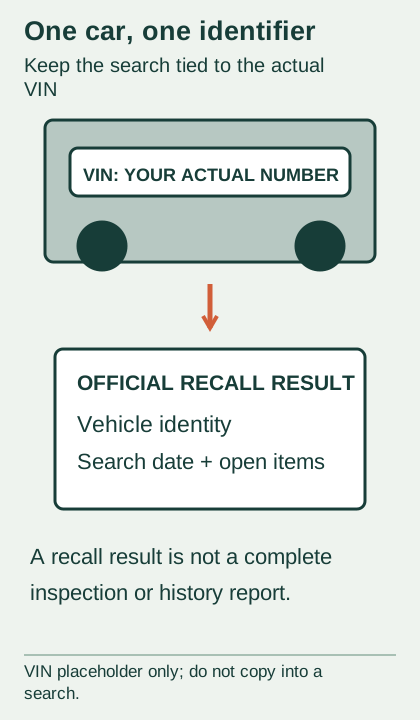
The diagram below shows the connection between a physical vehicle, its identifier, and an official recall result. The example number is deliberately a placeholder, not a VIN you should copy into a live search.

Read the entire result and its limits
NHTSA explains that its VIN search focuses on unrepaired recalls and does not show every possible category of vehicle information. Read the current limitations on the tool before you decide what an empty result means for your situation.
A result with no open recalls does not certify the brakes, tires, collision history, service history, or the quality of previous repairs. Those are separate questions that may require records, other appropriate checks, and a qualified inspection.
Likewise, a recall search is not a list of every service bulletin or non-safety campaign. If the manufacturer has separate service-campaign information, treat that as a different inquiry rather than expect one tool to answer everything.
Save the date and the result you actually saw. If you are comparing vehicles over several weeks, you want to know which check belongs to which car and when you performed it.
Avoid rewriting the result in stronger language than it uses. “No unrepaired recalls shown on this search date” keeps the scope clearer than “fully safe” or “all factory problems fixed.”
If a recall appears, read the campaign details
Open the relevant recall information and identify the affected condition, risk, and remedy information. You need to understand the actual campaign before deciding what questions to ask a dealer or manufacturer.
Follow any specific safety instructions attached to the recall. If the notice includes an instruction about driving, parking, or another restriction, do not replace it with a general assumption that recall work can wait until your next routine service.
Copy the campaign identifier into your notes so the conversation stays precise. A description such as “the electrical recall” can be ambiguous when a vehicle has more than one campaign or a history of several visits.
If something is unclear, ask the manufacturer or an authorized dealer what applies to the actual VIN. You can request an explanation without guessing whether a part is available or whether a particular symptom proves the recall condition exists.
Keep seller assurances separate from official remedy information. A seller’s statement may be useful context, but you still need the relevant records and confirmation that address the exact campaign.
Arrange the remedy with clear expectations
NHTSA states that manufacturers must provide a remedy for safety recalls, generally through repair, replacement, refund, or in rare cases repurchase. Read the campaign details and confirm the practical next steps with the manufacturer or dealer rather than assume every case uses the same appointment process.
Ask whether the remedy is available for your VIN and whether the dealer needs to inspect or order anything first. Confirm scheduling details directly instead of estimating the repair duration from another owner’s experience.
If transportation is a concern, ask what arrangements may be available for the campaign and your circumstances. Do not build your plan around an assumed loaner car, reimbursement, or same-day completion that nobody has confirmed.
Write down the contact date and the information you receive. A short record makes the next call easier if the appointment changes or a different service adviser picks up the conversation.
If the result seems inconsistent with a repair receipt, show the dealer the exact documents. Ask it to explain the status instead of deciding that the database or receipt must automatically be wrong.
Keep recall work separate from the buying inspection
When you are considering a used car, an open recall belongs in your decision record alongside other unresolved questions. It should neither disappear behind a clean-looking interior nor be treated as a complete description of the vehicle.
Ask how the seller plans to address any open campaign and get the arrangement documented before relying on it. If the timing or safety instructions do not fit your intended use, you can pause the purchase while you obtain a clearer answer.
Arrange an appropriate independent inspection when you need an assessment of condition. Explain that you have checked recall status, but do not suggest that the inspector can skip mechanical checks because the recall result looked reassuring.
Keep the inspection, title and history questions, service documents, and recall result in separate folders or clearly labeled notes. That makes it harder to accidentally treat one favorable answer as proof of the others.
You can then compare vehicles based on what you actually know and what remains unresolved. A careful decision does not require every record to be perfect; it requires you to recognize the gaps honestly.
Save proof and check again later
After recall work is completed, keep the repair order with the VIN, campaign information, date, and mileage. That gives you a specific document to show if a future search or sale raises a question about the work.
Ask the dealer how completion is recorded and what you should do if the public result does not yet reflect it. Do not assume a particular update time without confirmation, because your immediate concern is preserving accurate evidence.
Continue paying attention to official recall notices and future checks. A completed campaign does not prevent a different recall from being announced later, and ownership changes can make contact information especially important.
The practical outcome is simple: you know which vehicle you checked, what the tool showed, what the limitations were, and what follow-up remains. That is useful evidence for ownership or a purchase decision without turning a recall search into a blanket safety certificate.
Sources & scope
Checked October 15, 2026. Manufacturer examples apply to the named model and document. Reader scenarios and organization are original editorial explanations.
- NHTSA Check for Recalls — VIN search, open recall scope, search limitations and recall remedies.