Two similar names, two different destinations
When a shop asks about an air filter, your first question should be which one. The engine air filter and cabin air filter serve different air paths, so approving “the filter” without identifying it leaves room for a surprisingly basic misunderstanding.
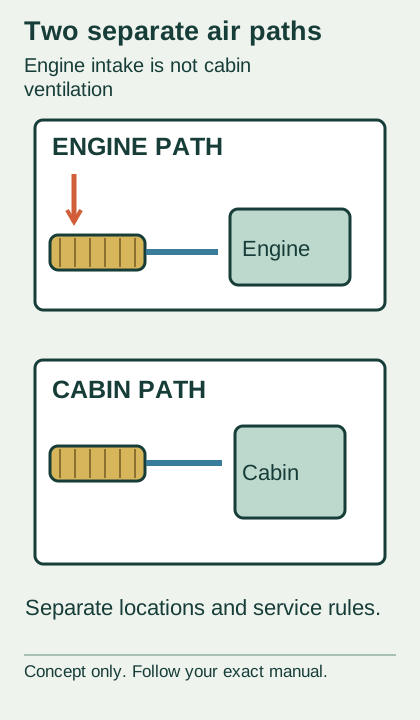
Your engine's intake air and the air delivered through your cabin's climate-control system aren't the same job. Once you connect each filter to its destination, you can ask better questions about maintenance, parts, and the symptoms you're trying to describe.
You don't need to pull either filter apart to make that distinction. Start with your owner's manual and an under-hood or interior diagram, then use the names there when you talk to a technician or shop for a replacement.
Follow the engine's intake path
The engine air filter belongs to the air-induction system serving the engine. Ford's 2023 F-150 engine-filter instructions emphasize using the correct element and preventing foreign material from entering that system during service, which makes protection and correct fit central to the task.
That isn't a reason to open the housing while the engine runs. The same Ford instructions explicitly warn against running the engine with the air cleaner removed or removing it during operation; use your own vehicle's shutdown and service instructions before attempting access.
If you're simply trying to identify the part, use the diagram and leave the housing closed. You can still record the correct name and location without turning a five-minute information check into a maintenance job you're not prepared to finish.


Follow the air that reaches your seats
The cabin filter belongs to the climate-control air path serving the passenger compartment. Ford's 2023 F-150 cabin-filter description says it reduces airborne particle concentration, including dust, pollen, and other particles, in air supplied to the interior.
That function doesn't make a filter a guarantee of clean air under every condition or a diagnosis for every odor. Describe what you're experiencing, including when it happens and which climate settings you used, rather than assuming that one replacement must solve it.
Cabin-filter access varies, so don't begin pulling trim because a video for another car shows a glove-box location. Find the procedure for your actual model and equipment, and check whether the instructions call for service by a shop or involve parts you don't want to disturb.
Turn a vague symptom into a useful question
If your concern is something you feel through the vents, start your conversation with the cabin system: “The airflow seems weaker than it used to at the same setting.” That is a useful observation for inspection, without claiming you've identified a clogged filter as the cause.
If your concern is an engine warning or a driving problem, replacing the cabin filter isn't a substitute for diagnosis. Tell the shop about the actual warning, behavior, and timing so the conversation doesn't get trapped by the first maintenance item someone mentioned.
For an original example, imagine you noticed an odor after parking outside overnight. Record that circumstance and whether it changes with the blower setting, then ask what needs inspection; don't buy both filters just because you can't yet name the source.
A useful repair request separates your concern from the proposed work. “Please inspect the reason for the airflow change and explain any filter recommendation” keeps the symptom visible, even if inspection eventually shows that another part of the system needs attention.
Ask to see the correct filter in context
When a technician shows you a dirty-looking element, ask which system it belongs to and whether it came from your vehicle. You want the condition connected to a specific part, its maintenance requirement, and the recommended action, rather than making a decision from an anonymous photograph.
Ask whether the recommendation follows the normal schedule, a special-use instruction, or an observed condition. Keeping those reasons separate helps you understand why the filter is being considered now without creating an imaginary universal replacement interval.
If you're comparing a shop's explanation with your manual, preserve the difference between “inspect” and “replace.” An inspection entry doesn't automatically prove a new part is needed, and a documented replacement requirement shouldn't disappear because the old element doesn't look dramatic in a picture.
You can request the replacement part number on the invoice and keep a photo of the packaging if you do the work yourself. That small detail makes the next service easier to identify, especially when a receipt describes everything with the same generic “air filter” label.
If you plan to replace one yourself
Read the complete procedure before ordering parts or removing covers. Check the required tools, fasteners, access method, and the exact element for your vehicle, then decide whether you can complete the work cleanly without improvising around an unfamiliar clip or connector.
For the engine filter, the cited F-150 procedure warns against allowing even small particles into the induction system. That is a concrete reason to prepare the area and follow the instructions, rather than treating an open airbox as a place to set tools or loose hardware.
For either system, pay attention to the documented orientation and sealing arrangement. If an arrow or marking is unclear, resolve what it means for that filter and housing before installation rather than assuming every arrow points toward the front of the car.
Stop if the new element doesn't fit as the instructions describe. Forcing a cover closed isn't a useful test of compatibility, and a similar outline doesn't establish that the media, seal, or frame belongs in that application.
Read the invoice as two separate services
A clear receipt should identify engine and cabin filter work on separate lines when both are performed. That lets you see what was inspected or replaced and prevents a later “filter done” note from becoming an unsupported answer to two different maintenance questions.
If you choose to postpone a recommendation, record that choice and the reason given by the shop. You can then review the unresolved item deliberately, rather than forgetting whether it was declined, found acceptable, or never inspected at all.
Avoid attaching an invented performance result to the work. A new filter and a completed receipt establish a maintenance event; they don't prove a fuel-economy improvement, a cured warning, or a particular air-quality outcome without suitable evidence.
Make the distinction stick
For an easy memory aid, label your notes by destination: “air to engine” and “air to cabin.” Under each, put the manual section, last documented service, and any question you still need answered, so the shared word “air” stops hiding the actual difference.
You can also practice explaining the distinction before a visit: one filter is part of the engine's air intake, and the other serves the climate-control supply to the passenger area. If your explanation starts wandering into guaranteed symptom cures, return to the actual function and the need for inspection.
The next time a service desk asks about an air filter, you can respond with a specific part and a specific reason for considering it. That gives you a much better starting point than accepting or rejecting a vague recommendation for a component you haven't identified.
Use a two-line request when you book service
You can make the appointment request concrete without diagnosing either system: “Please tell me whether the scheduled engine-filter inspection is due, and please inspect my cabin-airflow concern separately.” That keeps the two jobs visible even if the service desk later bundles them into one visit.
Ask the final explanation to preserve the same distinction. If only one filter was replaced, your record should still tell you which one it was and what happened to the other request, so an unanswered airflow concern doesn't disappear behind an engine-maintenance line on the invoice.
If you're ordering parts yourself, make two separate selections using the vehicle application information and the actual part name. Don't let an online cart's suggested bundle replace that check merely because both products contain pleated material.
Sources & scope
Checked October 15, 2026. Manufacturer examples apply to the named model and document. Reader scenarios and organization are original editorial explanations.
- 2023 F-150 engine air filter intake protection and specified element; engine off/no contamination. — 2023 F-150 engine air filter intake protection and specified element; engine off/no contamination..
- 2023 F-150 cabin air filter role in HVAC air particle reduction. — 2023 F-150 cabin air filter role in HVAC air particle reduction..