The large number on the bottle is only your starting point
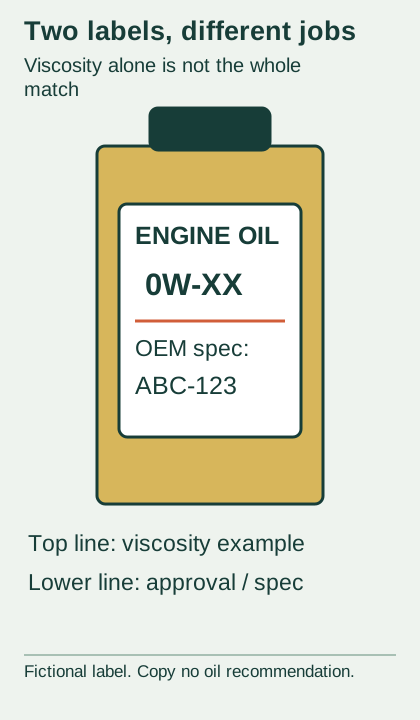
When you shop for engine oil, a familiar viscosity grade can make two bottles look interchangeable. Before you choose, you also need to match the performance and manufacturer requirements in your vehicle's manual, because the front label doesn't carry every part of the decision.
You can make the job manageable by taking a small specification card to the store. Put your vehicle and engine at the top, then copy the required viscosity, any performance category, and any manufacturer specification exactly as the manual presents them.
This is a label-reading method, not a recommendation to buy a particular brand or change the grade your car uses. If the requirement is unclear, resolve it with the vehicle manufacturer or a qualified shop before you add the oil.
Separate viscosity from performance information
API's motor-oil guide describes viscosity grade as a measure of oil's flow behavior at specified temperatures, while its service categories describe performance requirements. The same guide tells vehicle owners to follow the manufacturer's viscosity recommendation, so recognizing an API mark doesn't remove the need to read your manual.
For shopping purposes, think of those as different fields to match, rather than competing claims about which oil is “better.” A bottle can display an impressive performance claim while still failing to match the viscosity or vehicle-specific requirement you're trying to satisfy.
When you compare labels, look for the exact field each piece of information answers. Your notes might say “viscosity,” “required performance category,” and “manufacturer code,” which is more useful than a single checkmark beside a brand name.


Use an actual engine example carefully
Ford's online 2023 F-150 5.0-liter oil page illustrates the distinction by listing both SAE 5W-30 and Ford specification WSS-M2C961-A1. It also provides a separately specified cold-climate alternative, showing why even a named-engine example needs its surrounding conditions kept intact.
Those details are examples from that manual page, not oil advice for every F-150 or another model year. Check the engine, publication, and applicability on your own vehicle's documentation before copying any number or letter into your shopping card.
The example also shows why a partial search can mislead you. If you remember only “F-150 oil,” you haven't yet identified the engine or the instructions, and a plausible search result can appear to answer a question you haven't fully specified.
Read the back label and the exact product name
Once you have the requirement, turn the container around and compare the technical wording rather than relying only on the large front text. Check the precise product line and grade, because a brand may sell several oils in similar-looking packages that make different claims.
Keep a photograph of the front and back together if you want to confirm the choice later. A cropped image showing only the viscosity won't let you establish which product you bought, and a receipt may abbreviate the name enough to lose useful detail.
Pay attention to the wording used for any manufacturer code. If your manual requires an approval or a particular specification, don't silently treat a vague “suitable for” statement as the same thing; ask the manufacturer or oil supplier to clarify the exact product's status.
An online listing is also worth comparing with the bottle in your hand. If the photographs, grade, or specification text disagree, pause the purchase and resolve the mismatch instead of choosing whichever version supports the answer you hoped to find.
Know what the API marks help you check
API operates a licensing program for its oil quality marks and maintains a directory of licensed products. That can help you check a product identity when an API claim matters to your selection, but the directory isn't a substitute for your vehicle's requirements.
The current API guide distinguishes the Service Symbol from the gasoline-engine Certification Marks and explains the categories behind them. Use the guide to understand what you're seeing rather than assuming that every circular symbol, seal, or marketing badge represents the same program.
You don't need to memorize every category to buy one bottle correctly. You need to know what your manual calls for and be able to confirm that the exact product you choose makes the relevant, current claim.
If a product's identity or labeling remains questionable, pick a clearly documented option or contact the supplier. A low price isn't much help if you can't establish what the package contains or whether its claims match your vehicle's specification card.
Don't let broad marketing phrases finish the decision
Words such as premium, advanced, high mileage, and racing may catch your eye, but they don't fill in missing technical requirements. Treat them as descriptions to investigate after you've matched the fields your manual actually asks you to match.
The same approach applies when a friend recommends an oil that worked well in another car. Their experience may be sincere, but it doesn't supply your engine's specification or establish whether the same product and grade are appropriate for you.
If a shop proposes a different oil from the one in your notes, ask for the exact product and the reason it meets your requirements. You can have a useful conversation about documentation without arguing about brand loyalty or assuming the shop's recommendation is automatically wrong.
Keep any clarified recommendation in writing with the service record. That lets you distinguish an actual manufacturer-approved alternative from a casual suggestion remembered months later, especially if the alternative depends on a particular operating condition.
Keep quantity and product choice as separate questions
Once you've selected the correct product, decide why you're buying it: a planned oil change, an instructed top-off, or a spare container for a trip. Those situations involve different quantity decisions, even though the required oil identity may be the same.
Don't treat the listed oil-change capacity as the amount to pour into an engine that already has oil. If you're topping off, use the vehicle's checking and adding procedure, and resolve an unreadable level before deciding how much to add.
For a shop visit, ask the invoice to identify the oil actually supplied, rather than leaving only a generic “synthetic service” line. Your goal is a record you can compare with the requirement, not a stack of receipts that can't answer a basic product question.
Make the next purchase easier
Store your specification card with the manual reference and the date you checked it. Include a note to reconfirm applicability if you change vehicles, engines, or the document you're using, so a convenient old note doesn't become advice for the wrong car.
If you keep oil for more than one vehicle, label your storage arrangement clearly while keeping the original containers and their product information intact. Don't decant similar-looking oils into unmarked bottles that separate the liquid from the only identity you can verify.
At the checkout, give yourself a final three-part comparison: the right vehicle requirement, the right exact product, and the right intended use. That short pause does more for a confident purchase than trying to choose the most impressive phrase on the shelf.
For an original shelf-comparison exercise, imagine two bottles with the same large viscosity label but different fine print. Instead of asking which design looks more trustworthy, put each one beside your specification card and identify the exact requirement that remains unconfirmed.
You may find that one bottle answers every question while the other requires a supplier check. That doesn't prove the second oil is poor quality; it tells you that the evidence needed for your particular purchase is incomplete, which is a practical reason to pause.
Keep the final product photo with the card when you've resolved the choice. The next purchase then starts from an identifiable product and an actual requirement, while still giving you a reason to check that the label hasn't changed.
Sources & scope
Checked October 15, 2026. Manufacturer examples apply to the named model and document. Reader scenarios and organization are original editorial explanations.
- Viscosity and performance category are distinct; API marks and vehicle manual priority. — Viscosity and performance category are distinct; API marks and vehicle manual priority..
- 2023 F-150 5.0L example SAE 5W-30 WSS-M2C961-A1 and separately specified cold-climate alternative. — 2023 F-150 5.0L example SAE 5W-30 WSS-M2C961-A1 and separately specified cold-climate alternative..
- API licensing program and licensee directory exist; exact product identities matter. — API licensing program and licensee directory exist; exact product identities matter..